Tuesday, July 31, 2012

Updated: Meet the Designer: Joan Eagle of Chipita


Joan Eagle, a jewelry designer living in Colorado, has designed hand-crafted and hand-stitched earrings, necklaces, brooches and bracelets for over 30 years. Her company, Chipita, began in 1976.

CB10
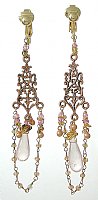
Most of her jewelry includes semi-precious stones, especially the most unusual varieties from all over the globe. Joan also uses Swarovski crystals and glass beads that were only made in Europe before World War II and have not been made since. The stockpiles of these vintage beads are diminishing making her jewelry even more of a treasure for collectors (vintage glass/amethyst earrings shown below.)


Each piece of Joan's handcrafted jewelry is unique, especially when semi-precious gemstones, with their natural colorations and inclusions are utilized.  Her vintage collection (examples above left & right) was made popular in the 1980's while her more modern works-of-art are part of the 21st Century collection (examples left & right). Still using precious stones, Austrian crystals, and other components, the 21st Century earrings have a more streamlined and delicate look, and since the vintage glass is becoming sparse, we will be seeing more of these beautiful creations.


Cliptomania.com proudly carries non-pierced Chipita earrings - dangles and buttons - in a variety of sizes, shapes, and colors.  Chipita in the Tomorrow's Heirloom section  contains Vintage, Buttons, and 21st Century selections.

It is important to note that the styles in Vintage and Buttons will not change as Chipita has shifted to only doing 21st Century styles. 


Wednesday, July 18, 2012

The Beauty of Pearls


Image from commons.wikimedia.org


Valued as a gemstone and an object of beauty, "pearl" has become a metaphor for something rare, fine, and valuable, and synonymous with the word elegance.


Image: www.aphotomarine.com


The English word "pearl" comes from the French "perle" originally from the Latin "pema" meaning leg, after the ham- or mutton leg-shaped bivalve. A bivalve is a class of marine and freshwater molluscs that have a laterally compressed body enclosed by a shell in two hinged parts. (i.e., clams, oysters, mussels and numerous others. See picture to right.)


The ideal pearl is round and smooth, however, pearls come in many shapes. A natural or "wild pearl," formed without human intervention is very rare.  For many years, finding and opening (and thus killing) hundreds of mollusks just to find one wild pearl was the only way they were gathered.  Now with the ability to "farm" pearls, cultured pearls (pearls made by nature with human intervention) make up the majority of pearls available on the market.


What is it?
Natural pearls are 100% calcium carbonate and conchiolin.  Viewed by scientists as a by-product of an immune system-like function, pearls are produced when microscopic irritants become trapped in the mollusk's mantle folds. The mollusk produces a sac to seal off the irritation and secretes the calcium carbonate and conchiolin to cover the irritant.

Physical Characteristics.
The luster of any pearl depends on the reflection, refraction, and diffraction of light from the translucent layers. The thinner and the more numerous the layers, the finer the luster. The iridescence is caused by overlapping layers that break up light. The very best pearls have an almost metallic,        mirror-like luster. In fact, according to jewelers, luster is the most important differentiation among all the qualities.  Pearls, especially the cultured freshwater pearls (explained below) can be dyed. 
Teardrop Sea Glass & Pearl Clip on Earrings (freshwater pearls)

Saltwater & Freshwater Pearls.

Although they look similar they come from different sources.  Forming in various species of freshwater mussels, freshwater pearls can be found in ponds, lakes, and rivers. Saltwater pearls originate in pearl oysters found in the oceans.


Cultured Pearls.
Cultured pearls are created in response to a tissue (irritant) implant within the mantle of the mollusk. This graft will form a pearl sac and the tissue will precipitate calcium carbonate into this pocket. Cultured pearls can be differentiated from natural pearls by x-ray examination (See diagram to left).  Most pearls on the market are cultured with the greatest majority coming from China and Japan.


Is it real?
Imitation pearls may look like the real thing, but will not have the same weight, texture or luster.  Some imitation pearls are made from mother-of-pearl, coral or conch shell while others may be made of glass and coated with a special solution containing fish-scales. Don't have an x-ray machine handy? You can do a quick test by rubbing two pearls together. Imitation pearls will be smooth, while cultured or natural pearls, composed of nacre platelets, will have a gritty feel against each other.


A lot of work....and time.
Before the 20th century, "pearl hunting" was the most common method, as divers pulled oysters from the ocean floors and river bottoms and individually checked for pearls. In as many as several tons, maybe four perfect pearls would be found. Farming pearls is also a long process. After grafts are made, it may be anywhere from one to seven years until harvest, depending on the pearl type.

Care.
On the Moh's scale of hardness pearls range from 2.5 to 4.5. Because pearls are organic they are 
KJK Pearl & Gems Clip on Drop Earrings
sensitive to acids, extreme heat, dry conditions as well as moist ones. Wipe pearls with a soft lint-free cloth as soon as you take them off. A dampened cloth can be used however, make sure pearls are dry before storage. Never put pearl jewelry in an ultrasonic cleaner, or use solutions that contain ammonia or harsh detergents. Extra care should be used in their storage. Pearls should be stored separately with other jewelry to avoid scratching or damage.

The mystic & folklore.
The pearl was adopted by the American National Association of Jewelers in 1912. It is considered the modern birthstone for the month of June as well as the birthstone for Sun Signs Gemini and Cancer. Pearls are also the traditional 3rd anniversary gift, the modern 12th anniversary gift, and certainly the 30th "Pearl Jubilee" anniversary gift.  Incorporated into many cultures mythology, pearls have been said to increase wealth (black or gold pearls), success (pink) and love (blue). Others claim it has protection power, especially for children. We can't forget it's purity attribute, as many brides wear pearls on their wedding day.

Cliptomania offers many non-pierced earrings featuring a variety of pearls, in various shapes, sizes and colors. To see these, click Genuine Pearls or do an Advanced Search using the filter option for pearl type.


Sources
Pearls In Myth, http://www.pearl-guide.com, 2011, 7/16/12.
Pearl, http://en.wikipedia.org, no date, 7/13/12.
Pearl Facts, http://jewelry.about.com, 2012, 7/17/12.
Birthstone Clip Earrings, Clip On Anniversary Earrings, www.cliptomania.com, 2012, 7/17/12.

Tuesday, June 26, 2012

Cliptomania Feature: Designer Katherine Kornblau


RG181
KJK Jewelry was established in 1985 by designer and CEO Katherine Kornblau.  Since that time, Katherine has evolved from selling handmade jewelry from her little red wagon by the beach into one of the most versatile and respected jewelry designers in her industry today.  Expanding on a lifelong love of global art and culture, Katherine spent time in Lima, Peru, and Guadalajara, Mexico and studied at the Ecole de Louvre in Paris while completing her Art History degree at Oberlin College.  Her international education and interests are reflected in her designs and are ever popular with museums and art galleries both nationally and internationally.

All aspects of business, from initial design through production to shipping, occur in their New York studio.  Each piece of jewelry is carefully designed by Katherine before being handcrafted by her and her skilled staff.  Utmost attention is paid to the quality and the detail of each piece.  Being handmade in the U.S.A. enables KJK to precisely match the customer's needs.  It also enables KJK to continuously expand their product line and to promptly meet customer deadlines.


RB503


Searching the world and reference materials, KJK brings designs that reflect our world's rich cultural diversity and variety of historical eras. Collections range from art deco to zoological, ancient Egypt to contemporary.


Gem113


Cliptomania.com is proud to offer earrings by Katherine Kornblau. Visit our website http://www.cliptomania.com/, and see Katherine Kornblau in Tomorrow's Heirlooms, or do an Advanced Search and filter by Designer to see all of her creations.


Wednesday, June 13, 2012

Gemstone Highlights: Jasper


Image: www.bernardine.com/gemstones/jasper.htm


Image: www.tademagallery.co.uk 
The word "Jasper" is a derivative from the Greek word for "speckled or spotted stone."  History traces jasper usage back to Assyrian, Latin, Greek, Egyptian and Hebrew eras.  There are biblical notations of the Hebrew priest's breastplate adorned with the stone (Exodus 28:15-21.)  Also, chapter 156 of the Book of the Dead required the amulet in the form of the Girdle Tie of Isis, placed at the throat of the mummy, to be made of red jasper, whose blood-like coloring would enhance the words of the spell: "You have your blood, Isis; you have your power."  Ancient Egyptians wore jasper scarabs as amulets. Black jasper was used for intaglio (hollowed out carvings) in Roman times. Jasper has also been used to adorn buildings, such as the Saint Wenceslas Chapel in Prague.

What is it?
Due to its grainy inclusions, it is grouped by itself, although it is considered a chalcedony (which is a rock texture made up of minute crystals.)  Jasper is a dense microcrystalline quartz, i.e. composed of very fine intergrowths of quartz and moganite.  On the Mohs Scale, denoting gemstone hardness where talc is a 1 and diamonds are a 10, jasper ranks at a 7.  It is typically opaque with a dull to pearly luster.  Because jasper polishes well, it is a frequent medium of cabochons, mosaics, and ornamental objects.  Color is attributed to finely disseminated organic, hematite or geothite particles.

The percentage of those foreign materials present in the stone determine its color, pattern, texture, and overall appearance.  Jasper is most commonly red and red-brown due to iron deposits, yet there is a variety of multi-colored, spotty and striped stones.  The dispersion of color and pattern labels its value.  Jasper has been given many names based on such things as its color, arrangement of colors, localities of occurrence, names of persons connected with the find, names that might appeal to potential purchasers or items made of jasper.  In researching this gemstone I found a minimum of 56 different names.

A black variety of jasper called "Lydian stone" was used as a touchstone, or a stone whose smooth surface when scratched with gold, silver or certain alloys, exhibits streaks that can be compared to streaks of known metals or alloys and thus provide a means of identification, including even measurements of such things as the material's gold content.

Where is it mined?
Jasper is found world-wide, though substantial mines can be found in Germany, Russia, France, India, Egypt and the United States.

Care and cleaning:
Jasper requires little care.  Simple cleaning of the stone with warm water and a soft cloth is appropriate to maintain its beauty.

Mystical Aspects:
Of course with 56+ names, I found that different stones have different meanings, mystical properties and healing powers attributed to them.  General mythology, especially with regard to the amulets, state that jasper is beneficial in the treatment of infertility.  It is also generally referenced as being protective in its ability to keep evil spirits away and protect against snake and spider bites.  As a balancing stone, it is said to be able to restore the body's energy, promote stabilization and healing, with the safest approach to wear the gemstone in skin contact to the troubled part of the body.  Noteworthy applications included the pancreas, sciatica and troubled toenails.  It is the mystical birthstone of October, and the "Bloodstone" jasper is the traditional birthstone of March.

https://www.cliptomania.com/ offers many non-pierced gemstone earrings including those made with Jasper.  To see them visit our gemstones & pearls page


Information Sources
en.wiki.org/wiki/Jasper
www.cst.cmich.edu/users/dietr1rv/Jasper.htm
www.gemselect.com/gem-info/Jasper/Jasper-info.php
worldwidestore.com
www.shopgemstone.com/jasper.html
"International Colored Gemstone Association" www.gemstone.org

Friday, May 25, 2012

Gemstone Feature: Amber


What is it?
Amber is fossilized tree resin (not sap) and technically not a gemstone but referred to as such (1)  Amber was first used as an ingredient in perfumes, then as a healing agent in folk medicine, and finally in jewelry. Originating as a soft and sticky resin, it can sometimes contain animal and plant material as inclusions. Amber occurring in coal seams is called resinite, and the term ambrite is applied to that found specifically within New Zealand coal seams.(2)

The English word amber derives from the Arabic anbar,  meaning “perfume.”  Amber from the Baltic Sea has been extensively traded since antiquity, and in the mainland, the natives called it glaes (referring to its see-through quality similar to glass.)(3)

Amber colors not only include the usual yellow-orange-brown that is associated with the color "amber", but can range from a whitish color through a pale lemon yellow, to brown and almost black. Other more uncommon colors include red amber (known as "cherry amber"), green amber, and blue amber, which is rare.  Much of the most highly-prized amber is transparent, in contrast to the very common cloudy or opaque amber. Opaque amber contains numerous minute bubbles. This kind of amber is known as "bony amber."
Tri-Color Amber & Pearl NP Clip Earrings

Formation
“Molecular polymerization” (molecule is the smallest particle of a pure chemical substance retaining it chemical composition and properties while a  polymer is a long, repeating chain of atoms) resulting from high pressures and temperatures produced by overlying sediment, transforms the resin first into copal. (Copal is a name given to tree resin that is particularly identified with the aromatic resins.)  Sustained heat and pressure drives off terpenes (Terpenes are a large and diverse class of organic compounds, produced by a variety of plants, particularly conifers) and results in the
formation of amber.(4) 

 
The overall chemical and structural composition is used to divide ambers into five classes, and Baltic amber is subclassified further. Best Field Indicators are color, density, toughness, softness and trapped insects. (5)(6)

If one wants to find out if their amber is natural or man made, the flotation test is recommended. Make a saturated solution of regular table salt and water and place the piece of amber in this mixture. If it floats, it is amber. If it sinks it is man made (some natural copals will also sink and you would need to make more scientific tests to make a determination).

Where
Historically, the coast around Königsberg in Prussia was the world's leading source of amber.  About 90% of the world's extractable amber is still located in the Kaliningrad Oblast of Russia on the Baltic Sea (which was previously Königsberg in Prussia, before World War II.)(7)

Filigree Teardrop  & Amber NP Clip Earrings


Pieces of amber torn from the seafloor are cast up by the waves, and collected by hand, dredging, or diving. Elsewhere, amber is mined, both in open works and underground galleries.  Dominican amber, especially Dominican blue amber, is mined through bell-pitting (a primitive method of mining coal), which is dangerous due to the risk of tunnel collapse.(8)

Notable occurrences beyond all Baltic countries include Venezuela; Russia; Romania; Burma; in coal seams in Wyoming, USA, and the Dominican Republic.

Stone Age Findings
Amber ornaments have been found in Mycenaean tombs (dating 13,000 years ago) and elsewhere across Europe.(9) Baltic amber also in cupola tombs of Mycenaean culture built on Crete Island were found during 1600-800 BC.(10)
Tri-Color Amber Chandelier  NP Clip Earrings

Mystical Meaning & Healing Properties
Beginning during the Stone Age and continuing throughout history, many cultures attributed special meanings and mystical properties to amber. Greek and Roman poets described amber as sun-dried tears or drops of the sun that spill into the ocean, and they are washed onto the beach. Beyond their poetic descriptions of its beauty, the Greeks wrote of amber's electrical characteristic. When rubbed with cloth, amber becomes electrically charged and attracts particulates.

Other uses include amber teething rings for babies because the stone is said to be a natural pain reliever. Said to absorb any negative energies, it is credited with restoring positive balance. Since amber is believed by some to carry the force of life, people who feel lethargic can wear it to restore their energy. If you're suffering anxiety or depression, amber is attributed to comforting people, and if you feel a little like the stiff tin man in the Wizard of Oz, problems like arthritis in the hand are relieved by wearing amber bracelets.(11)


http://www.cliptomania.com/ has an eighteen different styles of amber non-pierced earrings which can be found by clicking this link Gemstones& Pearls - Amber Clip On Earrings. You can also do an Advanced Search and type in the word "amber."


Works Cited
(1-7: "Amber", en.wikipedia.org/wiki, 05/25/12).
1.  Grimaldi, D. (2009). "Pushing Back Amber Production". Science 326 (5949): 51–2. Bibcode 2009Sci, p. 326.
2.  Poinar GO, Poinar R. "The Quest for Life in Amber", Basic Books, 1995, p. 133.
3.  Harper, Douglas. "Amber". Online Etymology Dictionary, www.etymonline.com, May 25, 2012.
4.  Rice, Patty C. (2006). "Amber: Golden Gem of the Ages". 4th Ed.. AuthorHouse.
5.  Jacobson, Douglas, 1997, TED Case Studies, “Amber Trade and the Environment in the Kaliningrad Oblast”, Case Number 451.
6.  Wilfred Wichard and Wolfgang Weitschat: "Im Bernsteinwald", Gerstenberg Verlag, Hildesheim, 2004.
7.  Anderson, K; Winans, R; Botto, R, "The Nature and Fate of Natural Resins in the Geosphere—II", 1992, "Identification, Classification and Nomenclature of Resinites", Organic Geochemistry 18 (6): 829–841. 

8.  "Mycenae Tombs", www.galenfrysinger.com, n.p. 05/25/12.
9.  "Amber Routes", amberartisans.com, n.p. 05/25/12.
10. "Amber", www.galleries.com, 1995, Amethyst Galleries, Inc., 05/25/12.

11. Titus, Christa, "Amber Stone Healing" and "What Is the Meaning of the Amber Stone?" www.ehow.com, n.p., 05/25/12. 

Tuesday, May 22, 2012

Meet the Designer: Nancy Neill


After being inspired by her mother’s jewelry designs, Nancy Neill left her job and took up full-time jewelry making. Now, over twenty-five years later, she continues to create original pieces that flourish at boutiques & museums across the nation.

Nancy spent her early life in New England, where participation in all things creative and her respect for history began. In her teen years, the family moved to Athens, Greece and began an adventure that would influence her for a lifetime. Extensive travel throughout the Mediterranean and European countries, visiting historical sites and art museums left a permanent impression.

Her college years were spent in the Midwest, where she studied art history to learn more about all the art she had experienced. Studies also included art education for elementary students. Later courses in interior design complete her educational background to date.

Career experiences include advertising agency work, owning retail home furnishing stores, and apparel store management which finally landed her in the San Francisco Bay Area as advertising and special events coordinator for a luxury Italian handbag manufacturer. This exposure to the world of fashion accessories in the naturally beautiful and creatively stimulating Bay Area began Nancy’s adventures in jewelry design.


It started as a hobby, when her co-workers kept literally buying the jewelry off her neck. And so it began… when her mother said: "If I were you, I would quit my job and start making jewelry full-time!" Nancy says, "Always listen to your mother!"

After heeding this sage advice, Nancy collected found objects, beads, buttons, charms and other findings to create unique one-of-a-kind pieces. Soon, her work was in many boutiques throughout the San Francisco area and grew to be a nationally represented collection.


She has since relocated to beautiful Fox Valley in Northern Illinois, where each piece of jewelry is individually crafted by Nancy and her jewelry artisans. Inspired by nature and the world around us, each item is carefully designed to celebrate nature, to commemorate events or remember visits to special places, or simply to express the individuality of the woman who wears it.

By using pewter and brass charms, semi-precious stones, Swarovski crystals, unique glass beads, and metal jewelry components, Nancy is able to create matchless pieces of art that capture the essence of what is life.

Cliptomania is proud to offer earrings by designer, Nancy Neill. Visit Nancy Neill under Tomorrow's Heirlooms section. 

Monday, May 14, 2012

Gemstone Highlights: Turquoise

Cliptomania.com carries many gemstone non-pierced earrings. From Agate to Zircon, many of our designer's earrings include various gemstones from around the world.  Amid the beauty I wondered about some gem specifics. Questions like....Where did it come from? What gives its distinctive color?  Is it common or rare?  ..and many others.  Of course the internet is full of "sources" for anyone to draw information; however, I have decided to glean the technical information from a handful of "trustworthy" sites, and also cite from a fun site with a  mystic point-of-view giving origins, meanings and healing properties that some people believe the gems possess
.
Turkish Bazaar Collection: Michal Golan Dangle Clip Earrings


Because turquoise is one of my personal favs, I'm going to start with it.

Prized for many years, this beautiful stone was used by the ancient Egyptians in jewelry and worn by pharaohs and kings and is probably one of the oldest known gemstones. King Tut's solid gold mask (below right) has inlayed turquoise, lapis, carnelian and onyx. The name turquoise may have come from the word Turquie, French for Turkey, because of the early belief that the mineral came from that country (the turquoise most likely came from Alimersai Mountain in Persia (now Iran) or the Sinai Peninsula in Egypt, two of the world's oldest known turquoise mining areas.)  Another possibility could be the name came from the French description of the gemstone, "pierre turquin" meaning dark blue stone.

Chemically, a hydrated phosphate of copper and aluminum, turquoise is formed by the percolation of meteoric or groundwater through aluminous rock in the presence of copper. For this reason, it is often associated with copper deposits as a secondary mineral, most often in copper deposits in arid, semiarid, or desert environments.  Even the finest of turquoise is fracturable, reaching a maximum hardness of just slightly more than window glass. The lustre of turquoise is typically waxy to subvitreous and its transparancy is usally opaque. Color is variable ranging from white to a powder blue to a sky blue, to a green-blue to a yellow-green.  The color depends on the minerals found in the area where it grew. The more copper in the mix produces a bluer stone. The more iron in the mix produces a greener stone.

In the ancient Persian Empire, the sky-blue gemstones were earlier worn around the neck or wrist as protection against unnatural death. If they changed color, the wearer was thought to have reason to fear the approach of doom. Meanwhile, it has been discovered that the turquoise certainly can change color, but that this is not necessarily a sign of impending danger. The change can be caused by the light, or by a chemical reaction brought about by cosmetics, dust or the acidity of the skin.
I found the general guidelines for caring for turquoise quite interesting. Prolonged exposure to the sun may discolor the gem. Being a phosphate mineral, it is also fragile and sensitive to solvents. Some perfumes and other cosmetics will attack the finish and may alter the color, as will most commercial jewelry cleaning
Turquoise & Jasper Multi Nugget Non-pierced Clip Earrings
solutions. Therefore, care should be taken when wearing turquoise and the use of sunscreen, lotion, or hair spray, which if used, should be applied before putting on turquiose jewelry, and then gently cleaning the jewelry with a soft cloth to avoid any residue build up.  It should also be kept in its own container to avoid scratching by harder gems, but the container should not be airtight.
Turquoise is one of the official birthstones for the month of December as adopted by the American National Association of Jewelers in 1912. It is the planetary stone for Aquarius, Taurus and Sagittarius. It is sacred to many Native American's and was carved in the shape of animals and birds. These carvings were placed in tombs to attract beneficial spirits and guard the dead. Turquoise was also used by medicine men for healing and by warriors who fixed it to the end of their bows to insure accurate shots.

Turquoise is considered one of the oldest protection amulets, and was also known as a symbol of wealth in many cultures. Other meanings associated with turquoise include: protection from negative energy, ability to bring good fortune, aid in promoting serenity and meditation as well as providing energy, wisdom, balance, honesty, communication, strength, friendship and love.

www.cliptomania.com offer's many non-pierced gemstone earrings including those with turquoise. To see them, visit the gemstone page of our website or do an Advanced Search, the elongated box under the website name to find a particular gemstone.


Sources
Turquoise, www.geminfo.com, n.p., 2010, May 11, 2012.

Turquoise, en.wikipedia.org, n.p., April 18, 2012, May 11, 2012.

Turquoise Gemstone Meaning, www.crystal-cure.com, n.p., 2011, May 14, 2012.